


- Home

- Ink Ingredients
- EuPIA Charter
EuPIA Charter
From Hazard to Risk: How the EuPIA Charter Strengthens Ink Safety in 2026
The printing ink industry has a long tradition of proactively managing the safe use of chemicals. Since 1996, the EuPIA Exclusion Policy has served as a cornerstone of this commitment, guiding ink manufacturers in eliminating or avoiding hazardous raw materials long before many regulatory frameworks were in place.
Today, as scientific knowledge, regulatory systems, and data availability have advanced significantly, the industry is entering a new chapter. The EuPIA Charter, introduced in 2026, represents the next evolutionary step: a modernized, science driven approach that maintains the high safety standards of the Exclusion Policy while aligning with contemporary toxicology and risk assessment practices.
This article outlines the background, principles, and practical implementation of the EuPIA Charter—and explains why it does not weaken but rather strengthens ink safety.
A Brief History, Meaning of Threshold, The EuPIA Charter
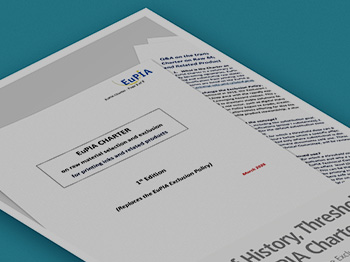
When the original EuPIA Exclusion Policy was created in 1996, chemical hazard data was scarce. The list therefore relied primarily on hazard classification, focusing on intrinsic chemical properties. Read our ePaper and learn more also about the Threshold and the EuPIA Charter.


A Brief History:
From Early Hazard Lists to Data Driven Chemical Safety
When the original EuPIA Exclusion Policy was created in 1996, chemical hazard data was scarce. The list therefore relied primarily on hazard classification, focusing on intrinsic chemical properties.
Since then, regulatory frameworks such as REACH or the National Toxicology Program of the U.S. Department of Health and Human Services have generated extensive datasets and systematic evaluation processes for tens of thousands of substances. With REACH alone, more than 30,000 chemicals have undergone assessment since 2007.
This vastly improved scientific foundation now makes it possible to differentiate more precisely between:
- Non‑threshold effects (e.g., genotoxic carcinogens) where any exposure may pose health risks
- Threshold effects (e.g., reproductive toxicity, STOT repeated exposure) where safe exposure limits can be defined
The EuPIA Charter leverages this knowledge.
What Do We Mean by a “Threshold”?
– Illustrated by Acetaminophen (Paracetamol)
In toxicology, a threshold describes a dose level below which no adverse health effect is expected to occur. Many toxic effects are threshold‑based, meaning that the body can tolerate a certain level of exposure without harm. A well‑known and intuitive example is acetaminophen (paracetamol). At its therapeutic dose, acetaminophen is safe and widely used as a pain reliever. However, at doses several times higher than the therapeutic level, it can cause serious liver damage. This illustrates a key principle: the hazard (the inherent ability to cause harm) does not change, but the risk depends on the level of exposure relative to the threshold. Modern chemical safety therefore does not ask whether a substance is hazardous in principle, but whether realistic exposure remains below a scientifically derived safe level.
The EuPIA Charter:
Evolving from Hazard-Based to Risk-Based Safety
The EuPIA Charter preserves the core philosophy of the Exclusion Policy—responsible and health‑protective chemical management—while integrating the modern principles of risk assessment.
What Stays the Same
- Substances with non-threshold effects remain subject to full phase‑out.
- Hazard classifications continue to guide the initial screening of materials.
- The industry maintains its preventive and conservative approach toward human safety.
What Changes
- Substances with threshold‑based hazards are no longer automatically rejected; instead, they undergo structured risk assessments.
- Decisions are based not only on hazard, but also on realistic exposure scenarios across the full value chain:
- Production
- Converting
- Consumer use
- Safe exposure limits are derived using internationally recognized toxicological methods and uncertainty factors.
- Substitution is still required when a safe use scenario cannot be demonstrated.
This approach ensures that decisions are scientifically robust and that substances are not replaced with alternatives that may have insufficient toxicological data—an issue frequently encountered during past phase out cycles.
Risk Assessment in Practice
Risk assessment translates toxicological knowledge into practical safety decisions by systematically comparing exposure with a scientifically derived threshold. Typically, thresholds are derived from animal studies. We explain more in our ePaper.

Risk assessment translates toxicological knowledge into practical safety decisions by systematically comparing exposure with a scientifically derived threshold. Typically, thresholds are derived from animal studies identifying a dose at which no adverse effects are observed. This value is then converted into a human safe level by applying internationally recognized uncertainty factors, accounting for differences between species and variability within the human population for instance. In practice, exposure is assessed across realistic scenarios, such as production, converting, and consumer use. For example, consumer exposure via printed materials can be estimated based on use patterns, surface coverage, and body weight. The resulting exposure value is then compared with the human threshold to determine whether use is safe. If exposure remains clearly below the threshold, continued use is acceptable; if not, risk management measures or substitution are required. This structured approach ensures that decisions are science‑based, transparent, and protective, while avoiding unnecessary phase‑outs that do not improve – and may even reduce – overall safety.
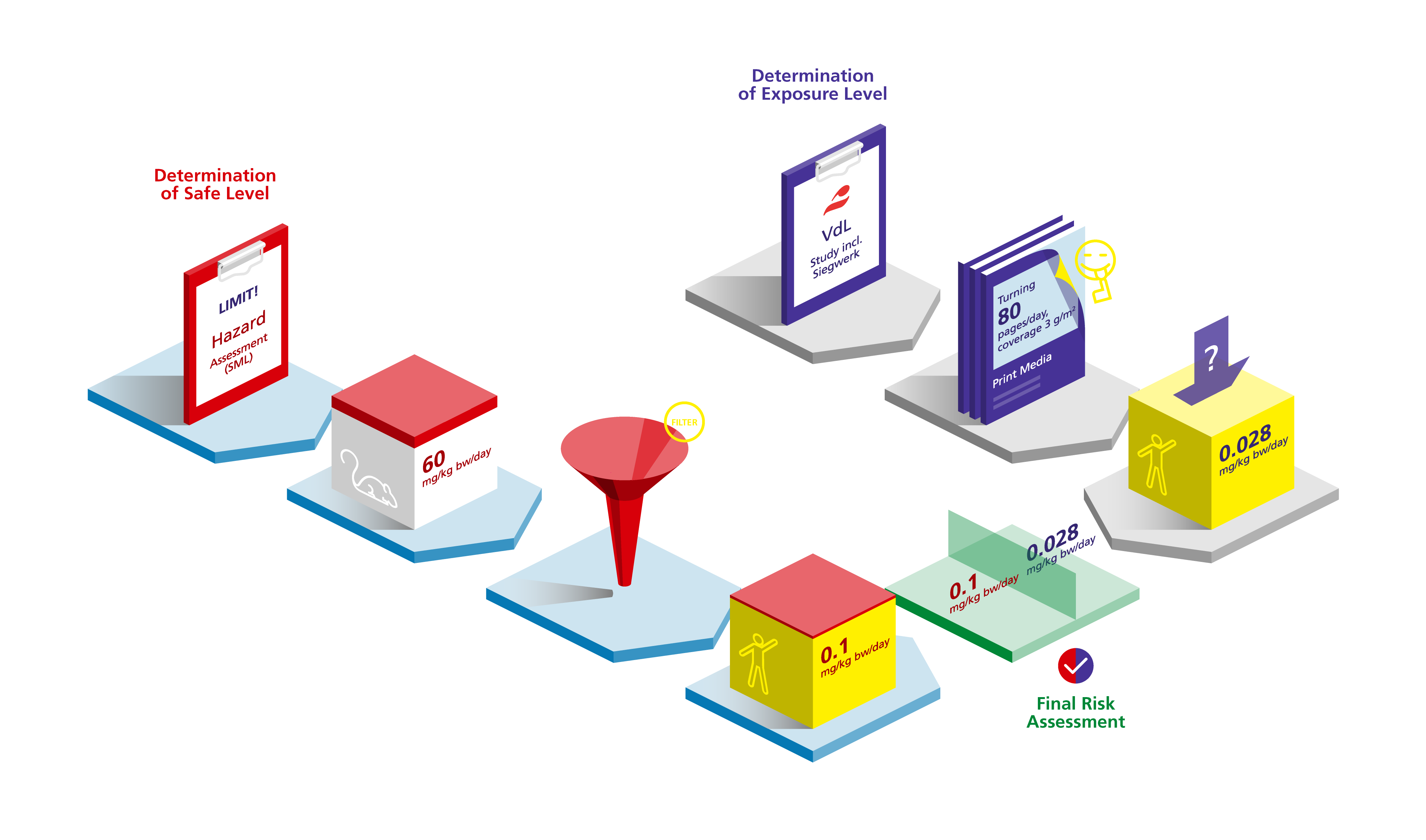
This can be further illustrated by the following real‑world example of a chemical risk assessment: the lowest level in the database of animal studies at which no adverse effects were observed for a the chemical in this example was 60 mg/kg bodyweight/day. This level was further reduced for humans using internationally recognized uncertainty factors to account for variability in sensitivity between the rats in the study and between rats and humans. In addition, uncertainty factors were introduced to account for a lifetime exposure of humans.
Based on these adjustments, the safe exposure level was determined to be 0.1 mg/kg bodyweight/day for consumers.
A worst case scenario for consumer exposure, which is based on a scientific publication, assumes that a person repeatedly licks their fingertips to turn magazine pages, transferring a small amount of ink each time. It is assumed that the person repeats this 80 times, leading to complete coverage of the fingertip with ink and hence, the chemical substance contained in it. Even under these exaggerated conditions, the exposure of 0.028 mg/kg bodyweight/day, is a factor of 3 below the safe level.
Risk Assessment in Action
The following infographic illustrates the analysis and interplay between Hazard and Exposure Assessment within the context of Risk Assessment, based on the findings of a study conducted by Siegwerk.



Why Risk Assessment Strengthens
the EuPIA Charter
Risk assessment is a well‑established and scientifically grounded process that is embedded in many chemical legislations and widely applied by both industry and authorities. Specific migration limits (SMLs) and other thresholds are the outcome of such risk assessments, typically derived from animal data using internationally recognized uncertainty factors. Compared to arbitrary phase‑outs, risk assessment provides a more robust and transparent approach, as phase‑outs often replace substances with known toxicological effects by alternatives with limited or no data. Under the EuPIA framework, a supplier’s self‑classification is already sufficient to trigger a Charter risk assessment, enabling proactive action well before any regulatory intervention. Overall, the systematic application of risk assessment is often the more effective way to maintain or increase the level of safety while ensuring scientifically sound decision‑making.